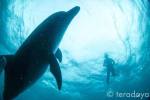
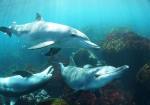
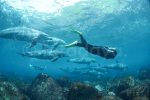
Bottlenose Dolphins near Toshima, Mikurajima and the other Izu Islands offshore of Tokyo swim seemingly peacefully- even willingly- alongside humans and enjoy full protection from the threat of capture or being hunted.
Humpback whales and bottlenose dolphins are known to play together. Observed off the coast of Hawaii, whales lifted dolphins high into the air so the dolphins could use the whale’s head as a slide back into the water. via tea_and_biology
Pacific bottlenose (T. gilli) are an entirely different species, usually the ones captured from Taiji. They are migratory, and tend to be not only very dark in color, but bulkier too. You will mainly see them in Asian, Middle Eastern, Polynesian and some Eastern Europe facilities (since those are Isana Union’s clients). SeaWorld and Sea Life Park still have a few when they did experimental captures in the Pacific.
According to Karen Pryor, animal behaviorist and former dolphin trainer at Sea Life Park, she described in Lads Before the Wind that T. Gilli were much more difficult to train than their Atlantic counterparts.
(a Monkey Mia pod member, via Arkive) Indo-Pacific Bottlenose (T. Aduncus) are also a unique species. They tend to live around Japan, both Koreas, Australia, Phillippeans, Indonesia, and the Eastern side of Africa. Indo-Pacifics have more rounded dorsals, have spotted underbellies, leaner builds and longer beaks (they look quite similar to Atlantic Spotted, minus uniform coat of spots).
This species has been mainly caught in these areas, including the Penghu Island, Taiwan dolphin drives. These drives (before they were effectively abolished) caught a fair number of dolphins. Those dolphins were sent to Ocean Park Hong Kong, and to the United Kingdom during the 1970′s and 1980′s. An untold number were also caught for Japanese parks and off South Africa for the local parks, Ushaka MarineWorld and Bayworld. Currently Ocean Park, Ushaka, and SeaWorld Gold Coast in Australia displays them. South Korea did have a few that were illegally captured for local park, but were later relinquished, rehabbed and successfully released.
(On that note, there is a unique population of Indo-Pacifics off Toshina Island, Japan, that are legally protected. Diver Nana Takanawa follows them pretty closely and has a Vlog of her dives with them.)
(Castaway – via Marine Mammal Conservancy) Believe it or not, there is an Offshore ecotype of Atlantic Bottlenose! Pinky/Patches of Monterey Bay is considered an offshore. As far as I am aware of, only two stranded individuals, Castaway (Dolphin’s Plus, 2006-2010) and Nai’aili (Dolphin Research Center, 1982-1987) were ever kept in captivity.





 wishwhale