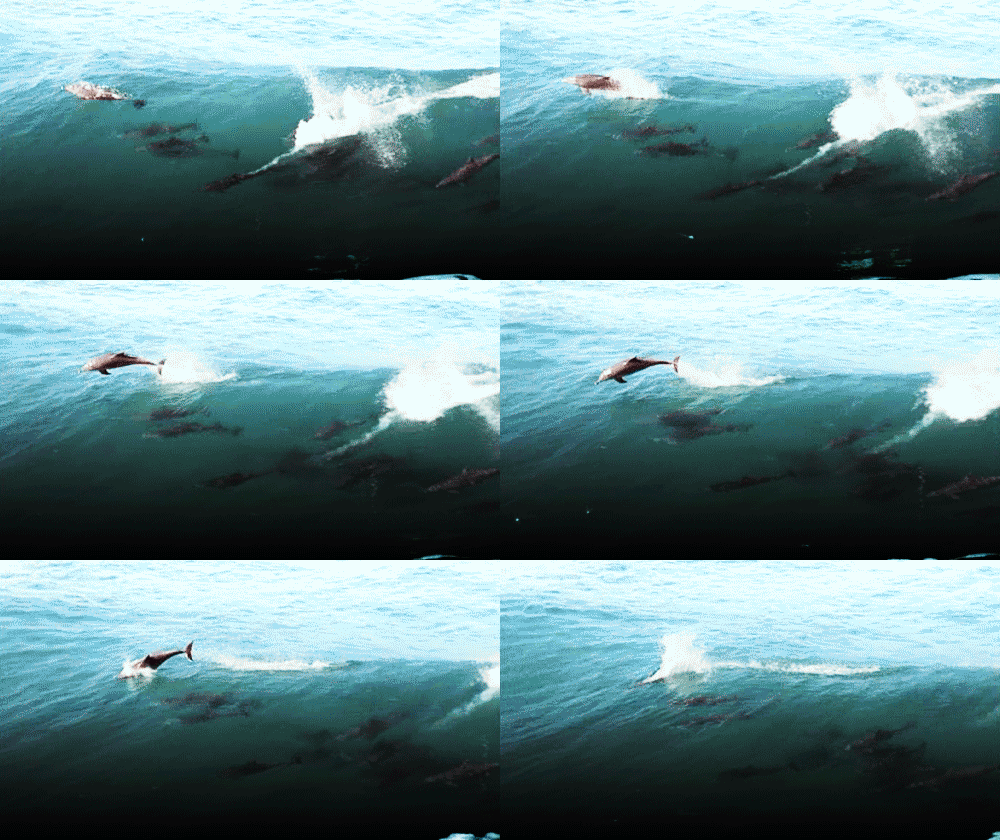
Humpback whales and bottlenose dolphins are known to play together. Observed off the coast of Hawaii, whales lifted dolphins high into the air so the dolphins could use the whale’s head as a slide back into the water. via tea_and_biology
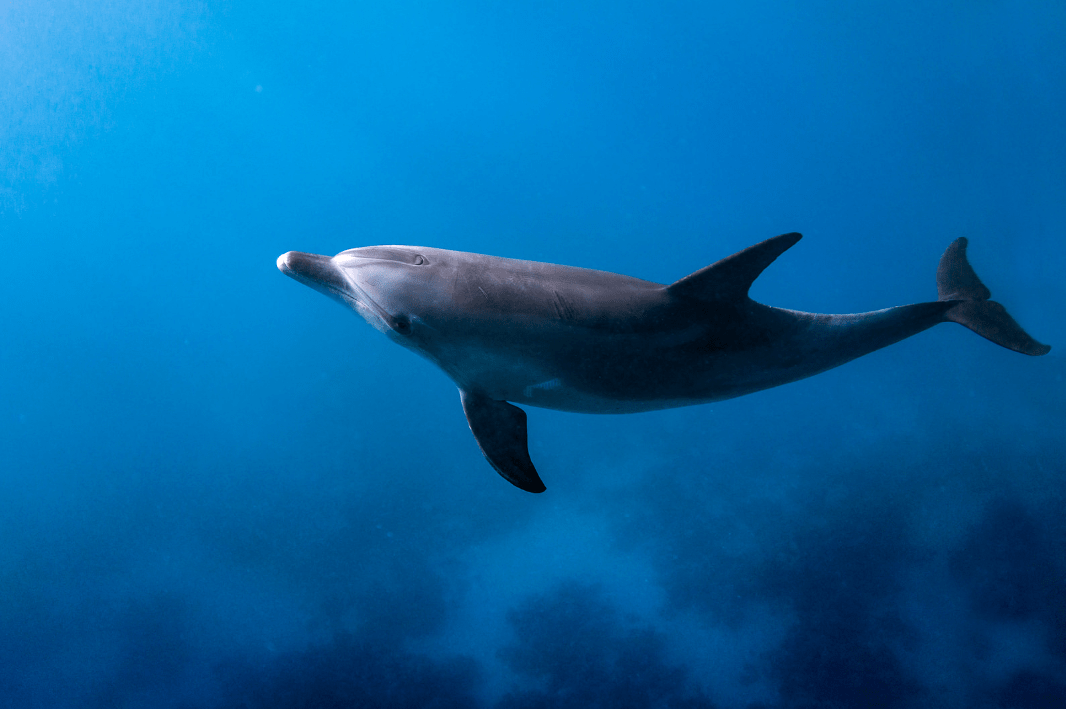
Pacific bottlenose (T. gilli) are an entirely different species, usually the ones captured from Taiji. They are migratory, and tend to be not only very dark in color, but bulkier too. You will mainly see them in Asian, Middle Eastern, Polynesian and some Eastern Europe facilities (since those are Isana Union’s clients). SeaWorld and Sea Life Park still have a few when they did experimental captures in the Pacific.
According to Karen Pryor, animal behaviorist and former dolphin trainer at Sea Life Park, she described in Lads Before the Wind that T. Gilli were much more difficult to train than their Atlantic counterparts.
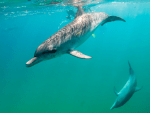
(a Monkey Mia pod member, via Arkive) Indo-Pacific Bottlenose (T. Aduncus) are also a unique species. They tend to live around Japan, both Koreas, Australia, Phillippeans, Indonesia, and the Eastern side of Africa. Indo-Pacifics have more rounded dorsals, have spotted underbellies, leaner builds and longer beaks (they look quite similar to Atlantic Spotted, minus uniform coat of spots).
This species has been mainly caught in these areas, including the Penghu Island, Taiwan dolphin drives. These drives (before they were effectively abolished) caught a fair number of dolphins. Those dolphins were sent to Ocean Park Hong Kong, and to the United Kingdom during the 1970′s and 1980′s. An untold number were also caught for Japanese parks and off South Africa for the local parks, Ushaka MarineWorld and Bayworld. Currently Ocean Park, Ushaka, and SeaWorld Gold Coast in Australia displays them. South Korea did have a few that were illegally captured for local park, but were later relinquished, rehabbed and successfully released.
(On that note, there is a unique population of Indo-Pacifics off Toshina Island, Japan, that are legally protected. Diver Nana Takanawa follows them pretty closely and has a Vlog of her dives with them.)
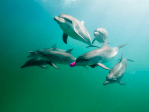
(Castaway – via Marine Mammal Conservancy) Believe it or not, there is an Offshore ecotype of Atlantic Bottlenose! Pinky/Patches of Monterey Bay is considered an offshore. As far as I am aware of, only two stranded individuals, Castaway (Dolphin’s Plus, 2006-2010) and Nai’aili (Dolphin Research Center, 1982-1987) were ever kept in captivity.
The United Nations designates June 8 as World Oceans Day, and this year the theme “Healthy oceans, healthy planet,” encourages individuals to consider actions that help protect the health of our oceans and our coastal communities. For those on the East Coast of the United States, the recent proposal by U.S. President Barack Obama’s administration to allow offshore oil and gas exploration in the Atlantic is cause for concern. Oil and gas companies use seismic airgun blasting to find oil and gas deposits, creating one of the loudest human-made noises in the ocean.
According to government estimates, as many as 138,000 whales and dolphins along the East Coast from Delaware to Florida could soon be injured or possibly killed if seismic blasting is allowed. These tests not only threaten marine life, but also the communities and industries that depend on their health. In observance of World Oceans Day, take a look at seven examples of marine life that could be affected by seismic testing.
The North Atlantic right whale earned its name from eighteenth century whalers as it was literally the “right” whale to hunt. After being hunted nearly to extinction, only about 500 individuals remain, making it one of the most endangered species on the planet. The whales’ only known calving grounds are located off of the coasts of Georgia and Florida, which are areas proposed for seismic testing. The blasting could lead to serious injuries and disturbances to the North Atlantic right whale, as well as negatively affect its critical habitat. Harming even one of the population’s females or juveniles could threaten the survival of the entire species.
Turtle ears may be small, but they’re sensitive. Seismic blasts could cause auditory injuries to sea turtles, and also lead to behavioral changes that could interfere with nesting. All of the sea turtle species in the United States — loggerhead, green, leatherback, hawksbill, olive ridley and Kemp’s ridley — are threatened or endangered. Many sea turtles nest on the coast from North Carolina to Florida — the same areas proposed for oil and gas surveys. The recovery plan for loggerhead sea turtles specifically mentions seismic airgun blasting as a threat to rebuilding populations.
In order to communicate with other whales, humpbacks use a complex combination of noises. The melodies are beautiful, underwater songs that fill listeners with awe. Seismic airguns emit a wide range of frequencies and the sounds in the lower frequency ranges are particularly troublesome for the musical humpback whale. The lower frequency sounds can travel thousands of miles from their source. In one recorded instance, humpback whales in a 100,000 square mile area stopped singing when subjected to the powerful sound of a seismic airgun near Scotland. Ending the humpback’s haunting song could impact migration, breeding and feeding.
Dolphins use clicks and whistles as a complex form of communication. Scientists have even observed bottlenose dolphins using distinctive whistles for individuals within their pod, similar to how humans use names. The loud and powerful blasts from seismic testing could cause temporary and permanent hearing loss in dolphins and whales. After seismic testing occurred near Peru, about 900 long-beaked common dolphins and black porpoises washed up dead along a stretch of beach. Upon examination, the dolphins were discovered to have had fractures in their ear bones and signs of bleeding from their middle ears.
Cod and haddock put the “fish” in fish and chips. As two of the most popular commercially caught stocks in the Atlantic, cod and haddock contribute to an $11.8 billion dollar fishing industry along the East Coast. Seismic testing could not only kill the eggs and larvae of commercially caught fish, such as cod and haddock, but also displace adult fish. After seismic testing was conducted in the Barents Sea, catch rates of cod and haddock declined by 40 to 80 percent for at least five days over thousands of square miles. The decline caused fishermen in the area to seek financial compensation for the loss of catch.
The Atlantic sea scallop fishery is the largest and most valuable wild scallop fishery in the world. The scallops are primarily harvested in Massachusetts, New Jersey and Virginia. While seismic testing has been proposed for the waters off of Virginia, the complete effects of testing on scallops and other shellfish such as lobster, oysters and crab are still being studied. However, after a seismic survey occurred in Australia in 2010, fishermen saw an 80 percent decline in scallops harvested, resulting in a loss of $70 million. If seismic testing were allowed along the East Coast, it could jeopardize the scallop industry and other important shellfish hatcheries and nurseries.
Sperm whales are capable of diving 3,280 feet below the surface in search of food, making them the deepest diving whale. Despite being such adept divers, scientists have observed beached sperm whale carcasses exhibiting signs of decompression sickness. Decompression sickness is the result of nitrogen bubbles forming in the blood stream when mammals decompress too rapidly. Noise from seismic airgun testing could startle marine mammals, including the sperm whale, causing them to rapidly ascend towards the surface. As SCUBA divers know, decompression sickness, commonly referred to as the bends, can cause serious problems such as confusion, severe pain, paralysis or even death.

 https://embedr.flickr.com/assets/client-code.js




 wishwhale


.jpeg?1433807394?interpolation=lanczos-none&downsize=*:1400)
