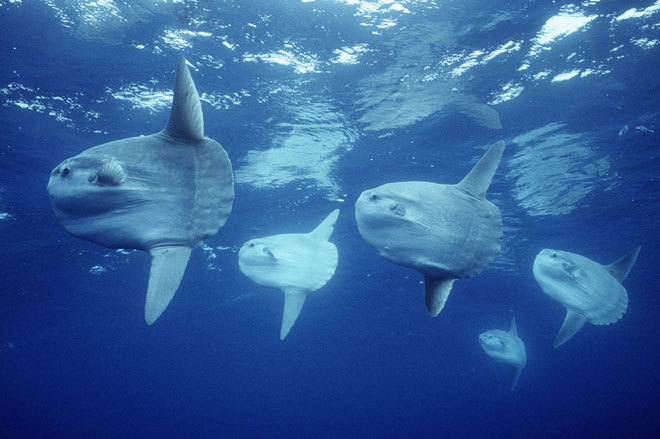
I love them so much because they’re about as sharp as a baseball and their anatomy is ridiculous to the point of them literally being classified as plankton for years because they just sort of get blown around by the ocean and look confused, but because they lay more eggs than ANY OTHER VERTEBRATE IN EXISTENCE, evolution can’t stop them
Why is no big predator coming and gnawing on them?
Their biggest defense is that they’re massive and have super tough skin, but they do get hunted by sharks or sea lions sometimes and they just sort of float there like ‘oh bother’ as it happens
Even funnier, because they eat nothing but jellyfish they’re really low in nutritional value anyway, so they basically survive by being not worth eating because they’re like a big floating rice cracker wrapped in leather.
Perfect example of “survival of the fittest” NOT meaning being some hyper aggressive, muscular manly asshole. This creature fell upon the complete opposite combination of traits and just rolled with it and evolution was like “well, it’s working, somehow".
reminder that this is what they look like when they hatch and they are smaller than a housefly
…..But they reach up to 800 pounds in barely over ONE YEAR.
Human teeth evolved from the same genes that
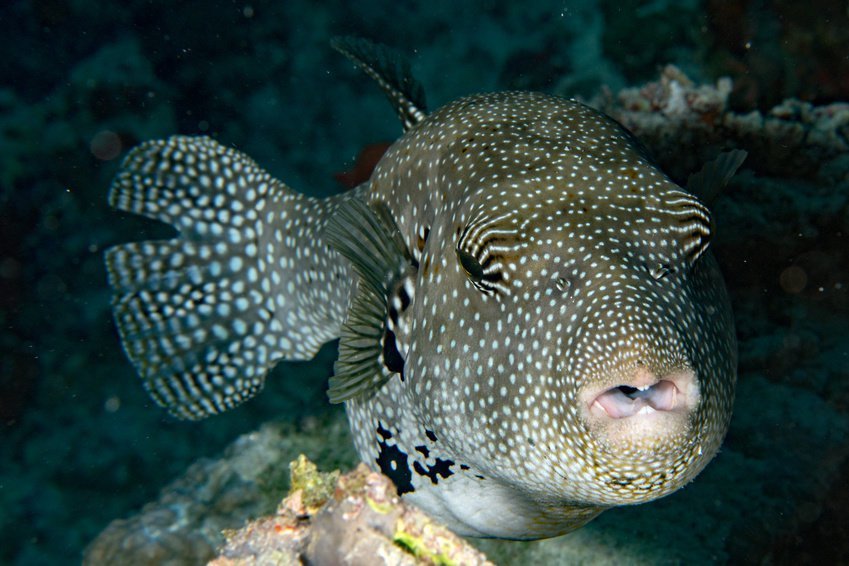
make the bizarre beaked teeth of the pufferfish, according to new
research by an international team of scientists.
The study, led by Dr Gareth Fraser from the University of Sheffield’s
Department of Animal and Plant Sciences, has revealed that the
pufferfish has a remarkably similar tooth-making programme to other
vertebrates, including humans.
Published in the journal PNAS, the research has found that
all vertebrates have some form of dental regeneration potential. However
the pufferfish use the same stem cells for tooth regeneration as humans
do but only replace some teeth with elongated bands that form their
characteristic beak.
The study’s authors, which include researchers from the Natural
History Museum London and the University of Tokyo, believe the research
can now be used to address questions of tooth loss in humans.
“Our study questioned how pufferfish make a beak and now we’ve
discovered the stem cells responsible and the genes that govern this
process of continuous regeneration. These are also involved in general
vertebrate tooth regeneration, including in humans,” Dr Fraser said.
Alexandre P. Thiery, Takanori Shono, Daisuke Kurokawa, Ralf Britz, Zerina Johanson, Gareth J. Fraser. Spatially restricted dental regeneration drives pufferfish beak development. Proceedings of the National Academy of Sciences, 2017; 201702909 DOI: 10.1073/pnas.1702909114
Rory L. Cooper, Kyle J. Martin, Liam J. Rasch, Gareth J. Fraser. Developing an ancient epithelial appendage: FGF signalling regulates early tail denticle formation in sharks. EvoDevo, 2017; 8 (1) DOI: 10.1186/s13227-017-0071-0






 https://embedr.flickr.com/assets/client-code.js
 wishwhale
