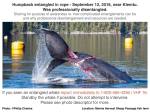
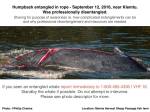
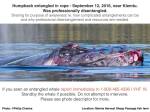
Humpback entangled in rope today [9/12/16] near Klemtu (Marine Harvest Sheep Passage fish farm). Was professionally disentangled. Locals will strive to relocate and monitor the whale. It is essential that coastal British Columbians know what to do if an entanglement is witnessed since, with increasing numbers of Humpbacks on BC’s coast, the risk of whale entanglement has become greater. Our preliminary results from research conducted with MERS / DFO suggest that over 47% of Humpbacks in BC have been entangled (>1,000 Humpbacks). This data provides an indication of how serious the risk of entanglement is but does not reveal how many humpbacks die after becoming entangled.
WHAT TO DO IF YOU FIND AN ENTANGLED WHALE.
– With great urgency, report the entanglement with location to the DFO Incident Line / VHF 16. 1-800-465-4336. – If at all possible, remain with the whale at a distance until trained help arrives or another boat takes over tracking, otherwise the chances of relocating the whale are greatly diminished. – Take whatever video/photos are possible but maintain a distance that doesn’t stress the whale. – Do NOT attempt to remove any fishing gear or rope from the whale as it risks human and whale safety (has led to human death). Professional training and equipment are needed to assess the entanglement and proceed safely with the greatest chance of success. Often, much of the fishing gear in which the whale is entangled is not visible at the surface. If well-intentioned members of the public remove the gear at the surface, it is made much more difficult to: (1) recognize that the whale is entangled; and (2) disentangle the whale even if it is relocated. Trailing gear at the surface provides the opportunity for trained responders to attach a tag to track the whale and/or to attach floatation to maintain contact with and slow down an entangled whale. Loss of this gear can significantly reduce rescuers’ ability to save the whale.
This humpback was lucky that there were people around to help disentangle it. It would have died from starvation had the ropes remained around its mouth like that. But of course, it is also our fault these whales become entangled in the first place. Our fishing line and ropes and nets are are death traps for these animals.
This really is not okay and I am so sick of paddle boarders thinking rules don’t apply to them. The media doesn’t help either when they publish these stories and make it sound like it’s okay to do this. It also doesn’t help that nothing is ever enforced and people who break these guidelines are never punished.
Do not be the stupid paddle boarder who jeopardizes the safety of an animal just for the “amazing experience”
For
a while now, scientists have known that fish are ingesting small pieces of
plastic. But it wasn’t clear how much of that was reaching our dinner plate.
Ecologist Chelsea Rochman wanted to find out.
“We
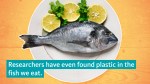
found plastic and fibers from textiles (e.g., clothing, carpet, fishing nets)
in about 1 out of every 4 seafood items sampled,” she
told the@huffingtonpost
The study,
which Rochman conducted while at UC Davis, was one of the first to directly
link plastic in the oceans to the fish on our dinner plates.
So
how concerned should we be?
“We
know much more about how plastic debris is harmful to fish and much less about
how plastic debris in our fish is harmful to our health,” Rochman explains.
Lab studies have demonstrated that plastic can get stuck in the guts of fish and
make them feel full. This changes their feeding behavior. Previous research from Rochman
demonstrates that small plastic debris can transfer harmful chemicals to fish.
This causes stress on the liver and changes the activity of genes related to
reproduction.
“Studies
have shown plastic debris in shellfish, fish and even sea salt. So, yes, we need more research
to answer questions about how plastic debris may impact food security (i.e.
fish stocks) and food safety.”
This
is what Rochman plans to study next.
“Seafood
is very healthy. It has essential fatty acids. I would never want to scare
anybody away from eating seafood,” She said. “We need to see if we need a toxic
threshold for plastic in fish.”
What
can the rest of us do?
The
recent ban on microbeads was a major victory. But
microbeads in products like toothpaste and face wash are just one part of the
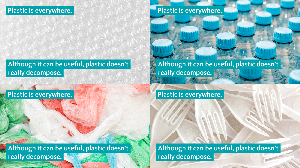
problem. Single-use plastic items — bottles, bags, plates, straws and utensils
— are also big contributors to the microplastic problem. The less we use, the
better.





 wishwhale