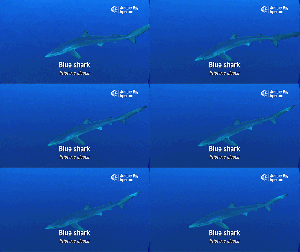
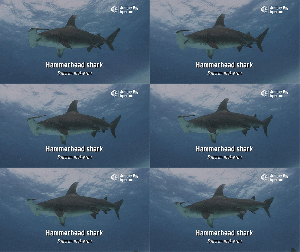
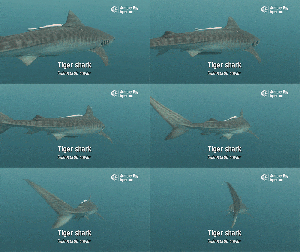
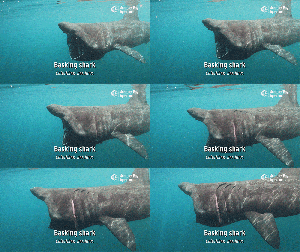
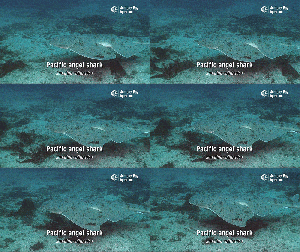
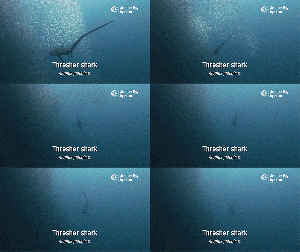
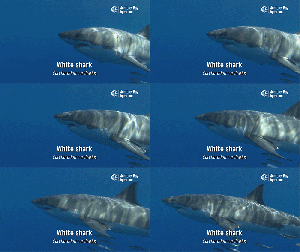
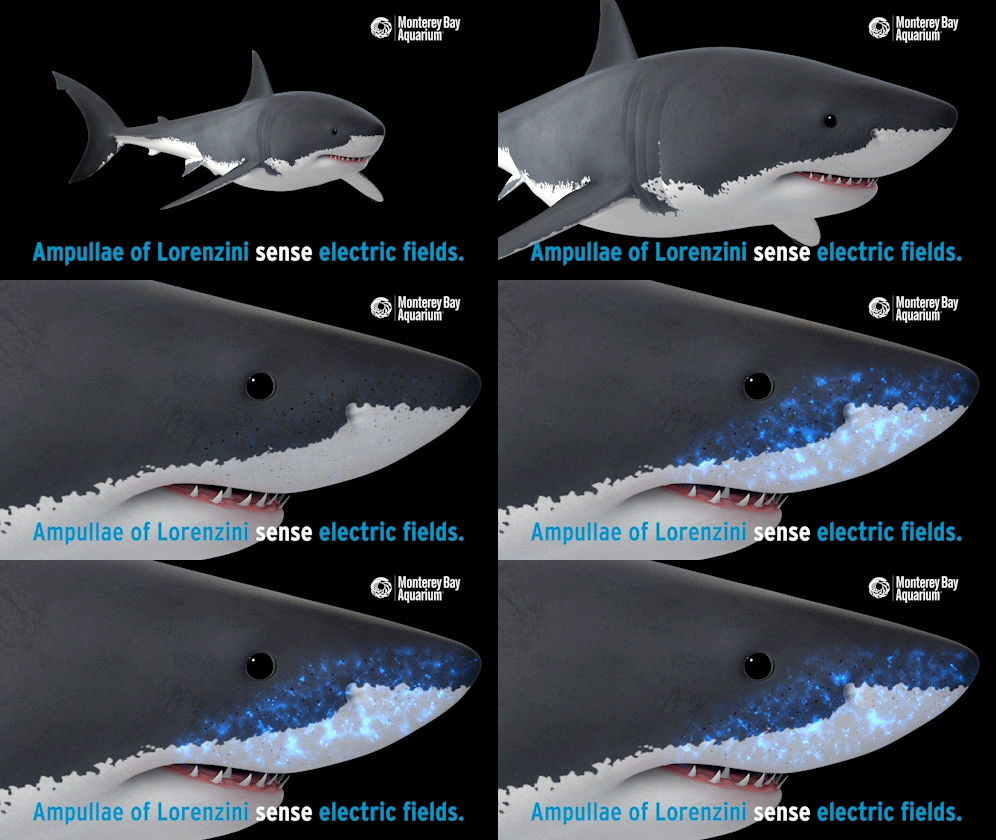
Fins up if you love sharks! There’s still a lot to learn about these fascinating, misunderstood creatures, but one thing we do know is that there’s a huge diversity of spectacular shark species gliding through our ocean.
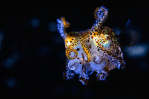
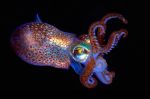
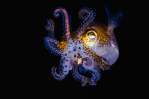
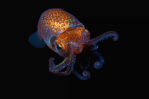
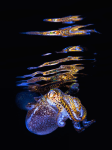
despite its colourful appearance, the hawaiian bobtail squid (euprymna scolopes) has the ability to render itself invisible to predators from bellow, thanks to a luminescent bacteria, vibrio fischeri, which inhabits a special light organ in the squid’s mantle.
the bacteria, which are fed a sugar and amino acid solution by the squid, produce luciferase, an enzyme that facilitates a biochemical reaction that produces light.
the nocturnal squid, who can control the amount of light produced by the bacteria, are able to ensure that they are not silhouetted when passing through the light of the moon or the stars by emitting an equal amount of light on their underside to that which hits them from above.
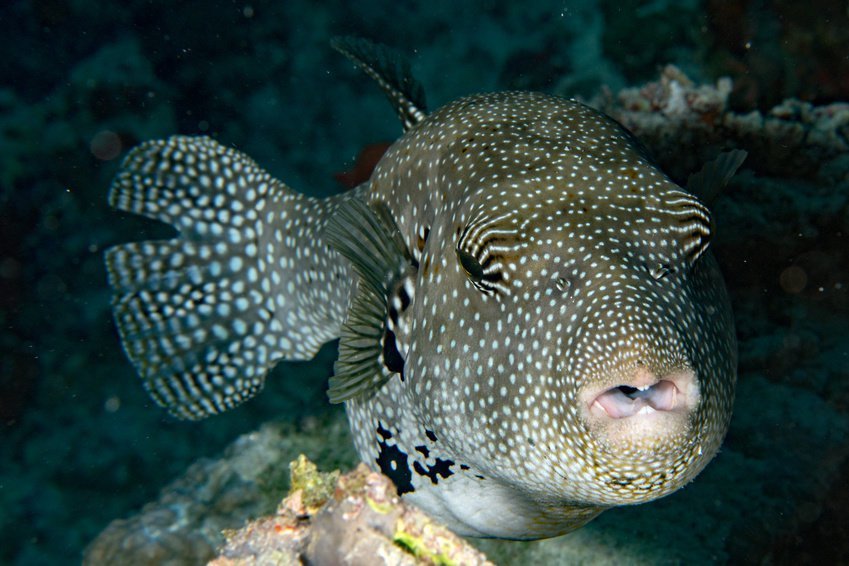
Human teeth evolved from the same genes that
make the bizarre beaked teeth of the pufferfish, according to new
research by an international team of scientists.
The study, led by Dr Gareth Fraser from the University of Sheffield’s
Department of Animal and Plant Sciences, has revealed that the
pufferfish has a remarkably similar tooth-making programme to other
vertebrates, including humans.
Published in the journal PNAS, the research has found that
all vertebrates have some form of dental regeneration potential. However
the pufferfish use the same stem cells for tooth regeneration as humans
do but only replace some teeth with elongated bands that form their
characteristic beak.
The study’s authors, which include researchers from the Natural
History Museum London and the University of Tokyo, believe the research
can now be used to address questions of tooth loss in humans.
“Our study questioned how pufferfish make a beak and now we’ve
discovered the stem cells responsible and the genes that govern this
process of continuous regeneration. These are also involved in general
vertebrate tooth regeneration, including in humans,” Dr Fraser said.
Alexandre P. Thiery, Takanori Shono, Daisuke Kurokawa, Ralf Britz, Zerina Johanson, Gareth J. Fraser. Spatially restricted dental regeneration drives pufferfish beak development. Proceedings of the National Academy of Sciences, 2017; 201702909 DOI: 10.1073/pnas.1702909114
Rory L. Cooper, Kyle J. Martin, Liam J. Rasch, Gareth J. Fraser. Developing an ancient epithelial appendage: FGF signalling regulates early tail denticle formation in sharks. EvoDevo, 2017; 8 (1) DOI: 10.1186/s13227-017-0071-0
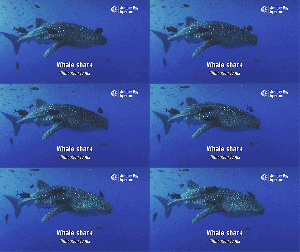
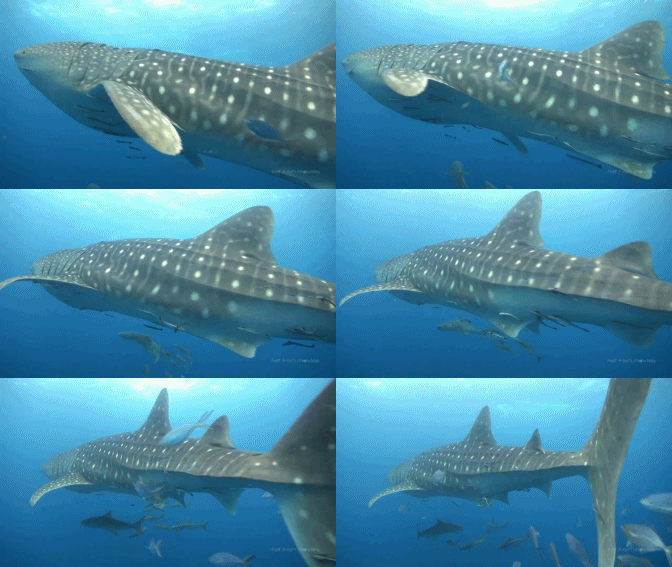
In a news release earlier this month, the IUCN revealed that increasing anthropogenic pressures (such as fishing and boat strikes) have caused the rapid decline of whale shark populations and that they should now be considered as endangered.
The International Union for the Conservation of Nature (IUCN) is the world’s main authority on the conservation status of species. The IUCN Red List evaluates the extinction risk of thousands of species based on a precise set of criteria, and the resulting evaluation aims to convey the urgency of conservation of a species to the public and policy makers.
Previously, whale sharks were ‘vulnerable’ to extinction, but their status has now been updated to ‘endangered.’ Their numbers have more than halved over the last 75 years as these sharks continue to be fished and killed by ship propellers.
Dr. Simon Pierce and Dr. Brad Norman, two prominent whale shark scientists have spent decades studying the animals and have co-authored the assessment that led to IUCN’s update.
“In our recent assessment, it was established that numbers have decreased more than 50 per cent in three generations – which we estimate to be about 75 years,” Norman explained. “The numbers on a global scale are really concerning.”
The main stressor to these gentle giants is the intense fishing pressure in several countries, including China and Oman, especially for shark-fin soup. Some other nations such as India, the Philippines and Taiwan have started implementing conservation plans and have ended large-scale fishing of whale sharks. While these efforts are admirable, it is now really important to push for more regional protection in these countries and to push other countries to try to save this species.
Whale sharks have been hard to study and to keep track off as they are quite cryptic and disappear into the open ocean fairly quickly. However with the use of modern technology and tagging devices, it has become a lot easier to follow them, collect information on them, but also to realize what kind of threats they are facing.
The species is just one step away from being critically endangered, an IUCN listing that is very hard to come back from.
“We cannot sit back and fail to implement direct actions to minimize threats facing whale sharks at the global scale,” said Norman, “It is clear that this species is in trouble.”
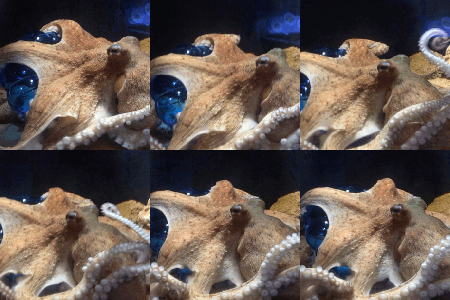
It’s been too long since I’ve posted an octo update, (or any update, really), and this feisty little lady has been up to some pretty cool things!
We recently got a set of hamster tubes to use for octo enrichment, and the set had a little blue lookout tower in it. Surprising everyone, our octo turned this sweet blue green color to match it! I had seen our reef octopus before her with colors like this occasionally, but never a common octopus. We also don’t have a lot of blue in that habitat, so she had no reason to be blue until her enrichment was blue! (She tends to be more rock/sand colored)
So, long story short: our lil kraken is still amazing and surprising and the best animal ever 🐙💜
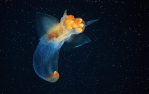
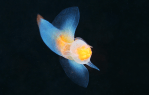
this is a sea angel (clione limacina), photographed by alexander semenov swimming with its wing like fins in russia’s white sea. these translucent pteropods, measuring only a few centimeters in length, are actually sea snails sans shells. lacking this cumbersome but protective shell, sea angels instead synthesize bad tasting compounds that dissuade predators from eating them. (see also: bobtail squid and josh lambus’ work)
[…] the calves’ careful whispers are not cries for food, as previously thought. Instead, they may help them stay in close contact with their mothers when swimming.
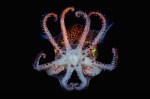
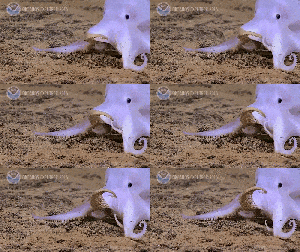
The Okeanos Explorer has discovered a very cute octopus at a depth of 4,290 metres.
This is the deepest an octopus of this particular sub order of octopus has ever been seen.
The National Oceanic and Atmospheric Administration noted this is a completely unsubscribed species and perhaps not belonging to any specific genus. Highlighting how little we still know about the creatures in the depths of our oceans.










 wishwhale