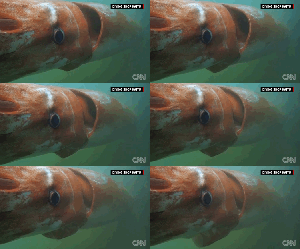
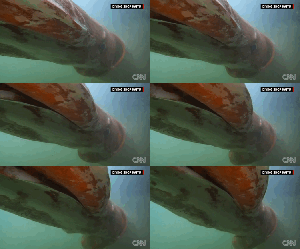
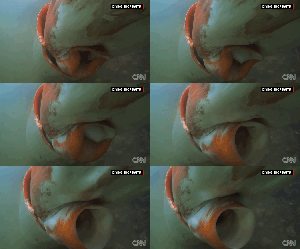
According to research from Charles Paxton, fisheries ecologist and statistician at Scotland’s University of St. Andrews, published in the Journal of Zoology this month, the giant squid could grow to reach as much as 65 feet. But even that is a “conservative analysis,” as size could protect against their #1 predator.
Wetlands not only provide homes for countless animals, they also protect the coast from the effects of extreme weather. See how the graduates of our Sea Otter Program are helping restore a wetland!
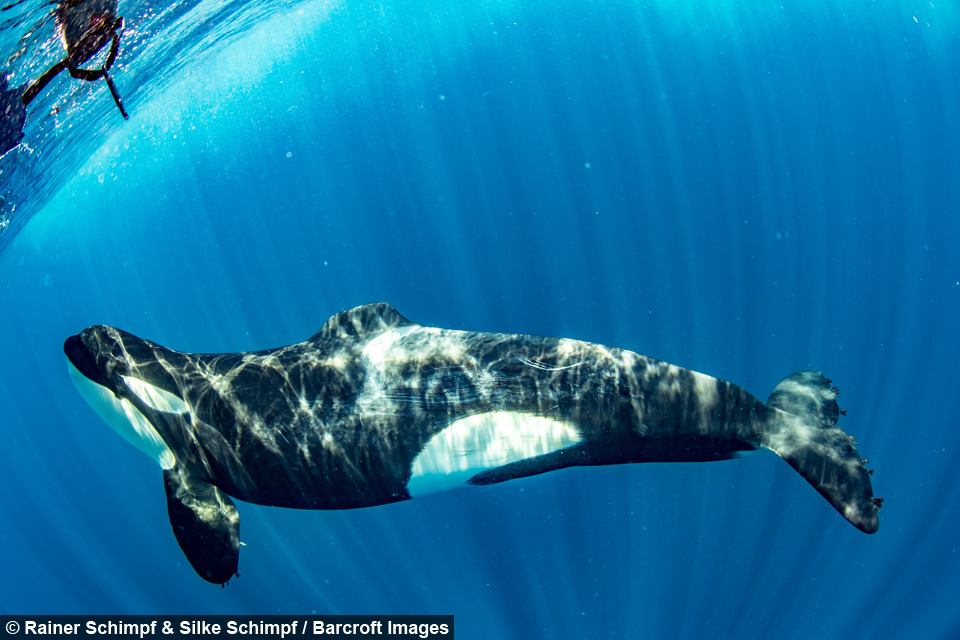
In 2013, photographer and marine tour guides Rainer and Silke Schimpf spotted a young killer whale, who they named Sira, with a missing dorsal fin and right-side pectoral fin, leaving him unable to hunt for himself.
But rather than be left to fend for itself or – even worse – die the young calf appeared to be cared for by members of its pod, which shared food with the youngster.
Four years later, by chance and coincidence, Rainer and Silke were out at sea in Algoa Bay, South Africa, documenting a pod of 1000 common dolphin hunting sardine when they had the surprise of a lifetime.
Rainer said: “We had been following this massive pod of dolphins for a couple of months with different film crews as well as tourists and on this particular day we encountered the dolphins we realised they were very nervous.
“Bearing in mind that orcas had been sighted in Cape Town about 800km away, 5-6 days prior, we knew that there was a good chance that orcas would actually be present.”
As the dolphins suddenly sped up, Rainer and his team noticed a pod of five orcas hunting the dolphin in front of the boat.
Rainer said: “We realised that one of the killer whales was our old friend Sira, who is a handicapped whale, which we had encountered first in 2013.”
When Rainer and Silke had first spotted Sira, the young killer whale appeared to follow the rest of the pod at a distance – swimming slower than the others and incapable to hunt.
But four years later, the couple were surprised to see that not only was Sira almost fully grown, but also appeared to be the leader of the pod.
Rainer said: “When we first saw that orca, he was a baby, about 3 and a half metres long and now this particular orca is almost fully grown to about 4 and a half to 5 metres and appeared to be the leader of the pod.”
The pod also included a female with a bent dorsal fin like the killer whale in Free Willy, a ‘huge male’ and four other females.
After spending an hour and a half following the pod of killer whales, Rainer and Silke headed back to shore with the hope that they will continue to encounter the friendly orca for years to come.
Rainer said: “It is obviously very interesting to us and any of the data that we collect gets sent out to diverse researchers.
“Hopefully there will be a happy end for Sira the orca and we will meet again and again.”
On May 23, 2000, the nonprofit American Tortoise Rescue established @WorldTurtleDay, to “help people celebrate and protect turtles and tortoises and their disappearing habitats around the world.” The obvious question is why an organization devoted to tortoises would care about turtles. Well, the answer is that turtles and tortoises are pretty similar. They’re both reptiles of the order Testudines, and they both rely on a shell for protection. Many species of turtle are at risk of extinction, but perhaps none as acutely as sea turtles—nearly all species are classified as endangered. And tortoises too are at risk as they continue to suffer from habitat loss. All said, turtles and tortoises are awesome and worthy of our protection (each and every day).
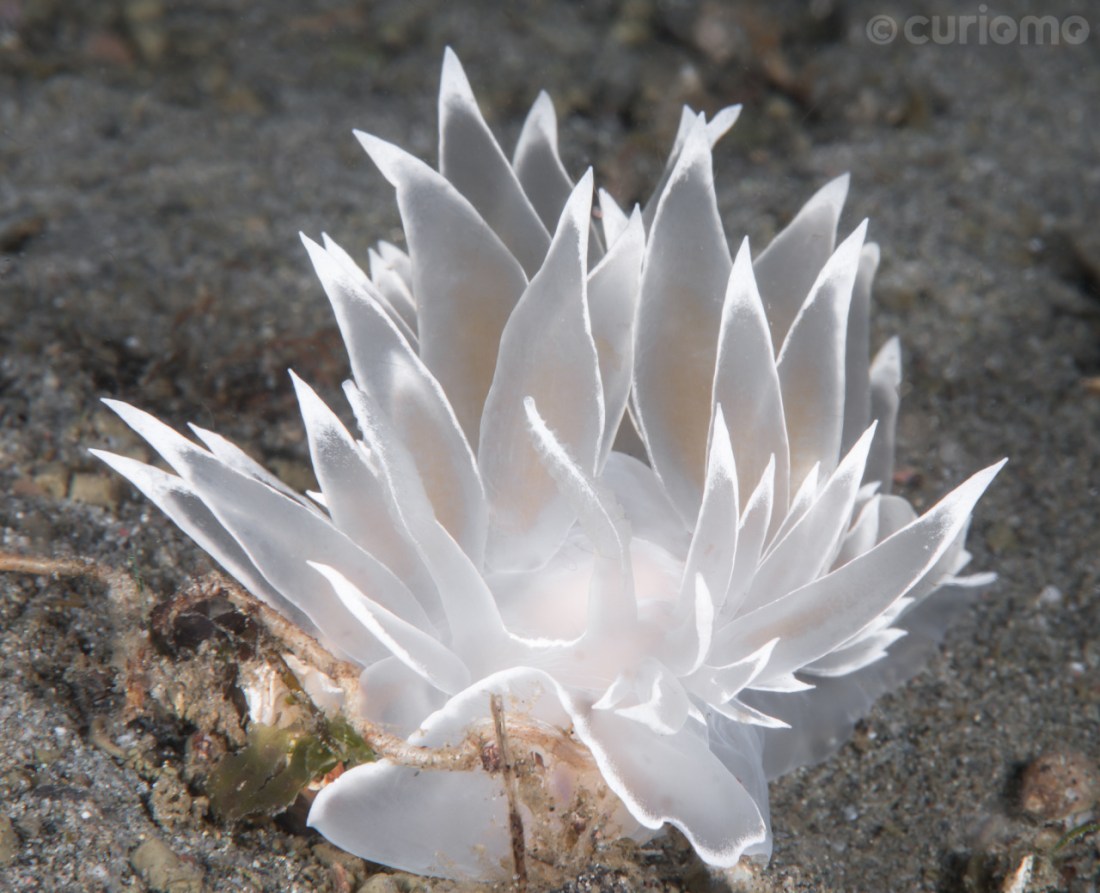
The Alabaster Nudibranch can be found in the temperate waters of the Pacific, from Alaska to California and along the coasts of Russia and Japan. The beautiful, wispy white tipped cerata are actually the animal’s lungs. But don’t let it’s delicate form fool you, this nudi’s jaws are strong enough to crack open the shell of a snail, one of its preferred meals – photo taken at Seattle, Washington
Horseshoe crab (Limulus polyphemus), on the western shore of the Chesapeake Bay at Fort Monroe National Monument, Hampton, Virginia.
Etymology note: What a puzzle! Polyphemus was the name of a Cyclops with a bit part in the Odyssey. The name translates many voiced, and might literally mean often spoken of, hence famous. It seems an odd choice, to name a creature with ten eyes after a creature with only one.
North american researchers at UC Berkeley and California Academy of Sciences have found that the larger Pacific-striped octopus has a unique hunting strategy: Rather than pounce on its prey, it stalks and gently taps it to startle it. Often this drives it into the octopus’s waiting arms….
The larger Pacific striped octopus ,
is, despite its name, no bigger than a tangerine. Also uses a “slow bounce” to hunt. With its body flattened, and dorsal arms reaching forward, the octopus glides with sporadic bursts of hopping movements before it snatches up its prey of choice.
The octopus is rare, in fact, science has yet no even give it a formal scientific name (belong to Octopus genus). Is poorly understood, however, a recent study shown, they are somewhat social, they mate face-to-face, and the females produce multiple batches of offspring.









 wishwhale